When Evelyn crosses the finish line this October at the Eversource Hartford Marathon 5K Charity Race, the moment will mean more than merely completing a road race. For Evelyn, every step will represent something that was once far from certain: the ability to walk, run, and move independently.
In December 2017, Evelyn was a busy sophomore at Manchester High School—an honor roll student, volleyball player, the kind of teenager who participated in nearly everything. “If there was a club at school, my name was all over it,” she said.
Then the unthinkable happened. She suffered a stroke at school.
Evelyn remembers the day well. It was cold and a fire drill at school took her and her classmates out into 20-degree temperatures. At lunch, she told friends that she wasn’t feeling right. She was experiencing chest pains on and off.
During an exam in her fifth period geometry class, “I started to get really light-headed. I couldn’t control my body. I was tilting to the side.” A classmate yelled for the teacher. “After that, it went blank.”
Waking up in the Emergency Department
Evelyn woke at Connecticut Children’s Emergency Department (ED) to find her terrified mother beside her—and discovered she could not feel her own body.
“I could see my mom touching me, but I couldn’t feel her touching me.”
Doctors and nurses rushed into the room, asking questions and examining Evelyn. “They were touching me, but I’m not feeling absolutely anything,” she said. She asked her mom to squeeze her hand. Still nothing.
Evelyn was admitted to the hospital for observation and further testing. At one point, a doctor pulled her mother out of the room to speak with her. When Evelyn saw her mother collapse to the floor, panic began to set in. “I was scared. My heart was beating so fast.”
A second stroke
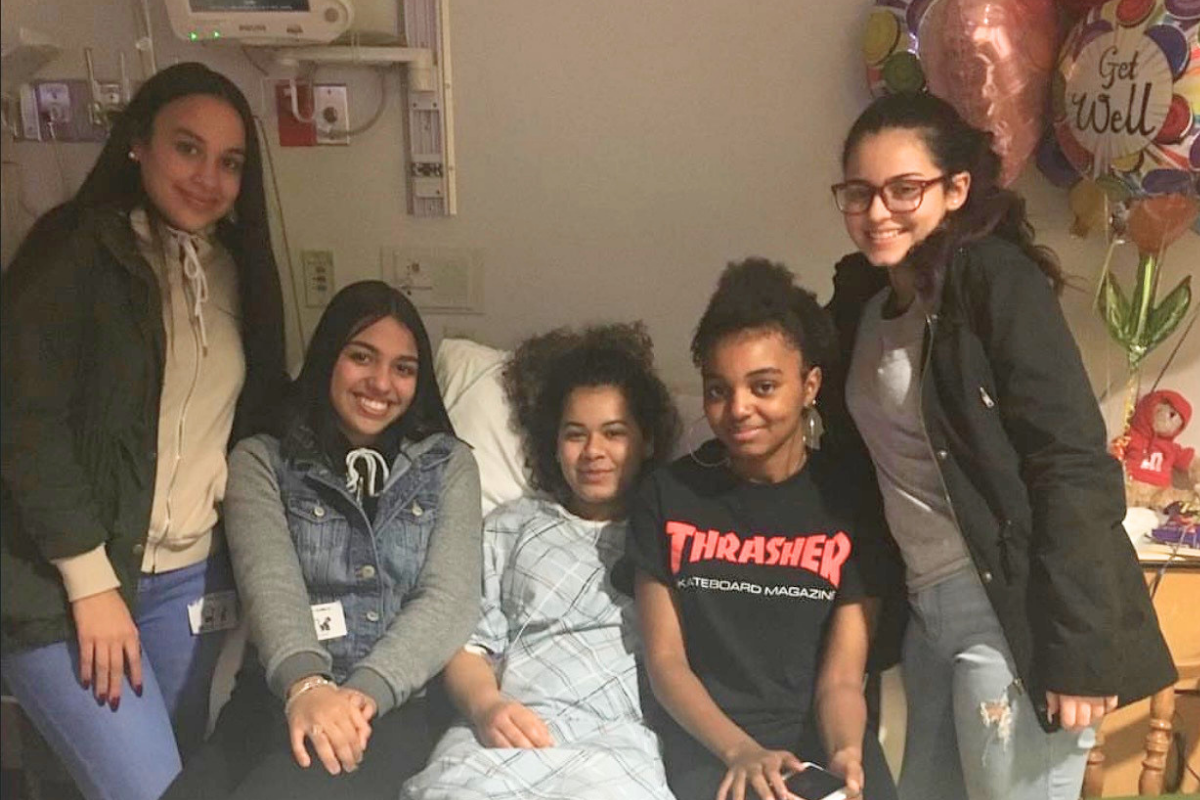
The next day, while friends from school were visiting, Evelyn suffered another stroke. When she awoke, her best friend and her entire family were in the room. But this time, she couldn’t speak.
“It was the scariest thing I’ve ever felt. My brain was telling me what to say, but my mouth wasn’t saying anything.”
For the next eight hours, she was trapped in an increasingly terrifying reality, unable to express the fears racing through her mind. “I didn’t understand what was going on with my body that had caused it to completely change.”
No longer able to feed herself or even brush her teeth or hair, she felt helpless and uncertain if she would ever recover. She needed her mother or a nurse to help her use the bathroom. In a matter of days, she had gone from being an active, outgoing teenager to feeling overwhelmed and deeply discouraged.
Through it all, her doctors and nurses took the time to explain what was happening in language a 15-year-old could comprehend. A medical interpreter translated information into her mother’s native language, Spanish, to help her follow her daughter’s rapidly changing condition and make sense of what was going on.
“When I gave up, they didn’t give up.”
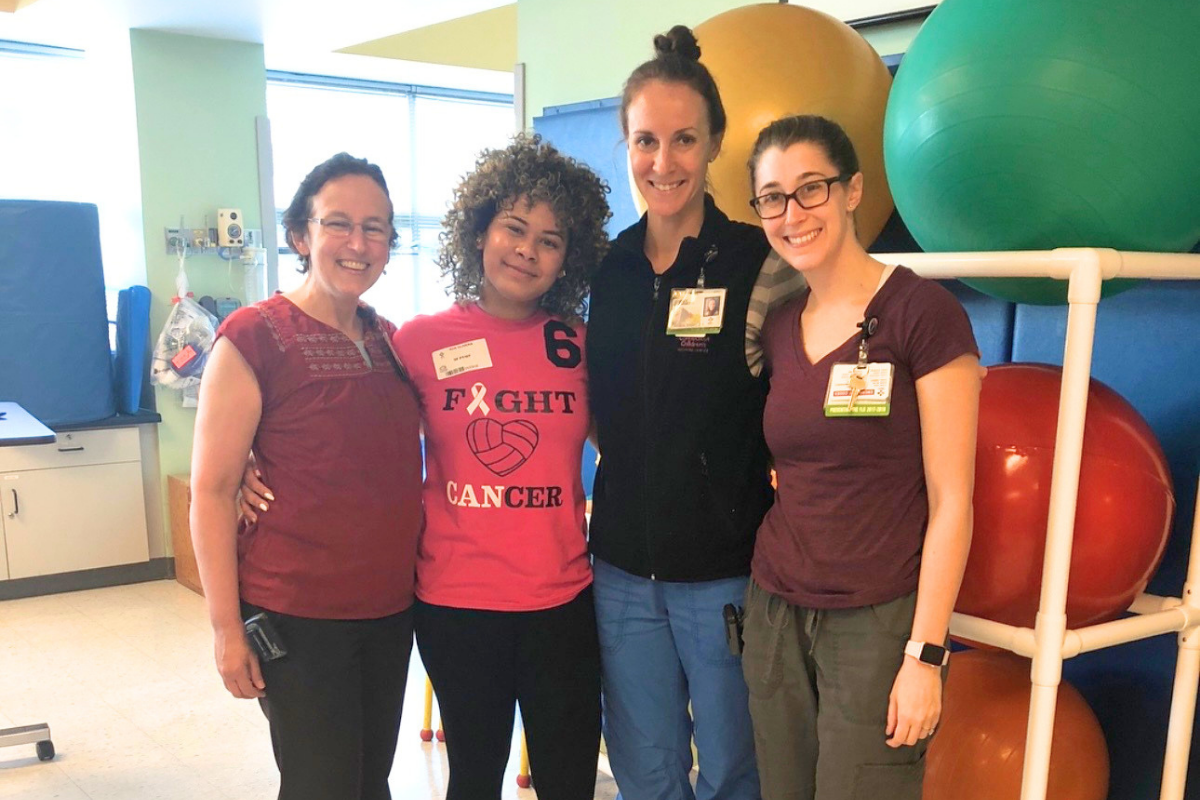
Connecticut Children’s physical therapists began working with Evelyn in the hospital, even when she struggled to believe recovery was possible. Videos taken by her mother showed just how discouraged she had become.
“You could see it in my eyes that I was kind of giving up,” she said. The physical therapy team continued to encourage and push her. “When I gave up, they didn’t give up.”
After seven days in the hospital, she was discharged. But going home did not mean that her care with Connecticut Children’s was over. For the next year, she would return three times a week for physical and occupational therapy.
A long road back to independence
Leaving the hospital also did not mean going back to the normal life of a teenager Evelyn had known before. “The transition from hospital to home was difficult, because I wasn’t independent anymore,” she said.
Her mother left her job to care for her, and her younger brothers, nine and ten years old at the time, became devoted helpers. They made her sandwiches, brought her water, and helped her move around the house. Their sandwich-making skills occasionally involved too much mayo, Evelyn recalled, and they were not particularly talented at brushing hair. But they were fiercely protective of their older sister.
Understandably, Evelyn felt angry at life. Strokes in teenagers are extremely rare, and hers had stripped away things most people take for granted: speaking, walking, feeding herself. She might never again play her favorite sport, volleyball.
It would be four months before she was able to walk without support or someone next to her. Even after she was cleared to use the stairs at school, climbing them could take 30 minutes. Balance problems prevented her from carrying a backpack, and she described her early gait as “like a little penguin, wobbling side to side.”
Making the most of a second chance
After a summer filled with determination and physical therapy, Evelyn began her junior year of high school. Fine motor skills—like those needed to hold a pen and take notes in class—were still a challenge, but she was able to run again and returned to the volleyball team. “I pushed myself and tried so hard to keep up with my teammates, but I was unable to do what I used to do. I couldn’t move as fast, and my body just wouldn’t cooperate the way I wanted it to.”
Her teammates and coaches gave her the support she needed to persevere. “They knew I was having a difficult time, and instead of making me feel like I couldn’t contribute, they found ways to use my skills to help the team. Being able to still contribute and feel like I had something valuable to offer helped me tremendously with my mental health. It kept me from feeling useless, and it was a big part of why I didn’t quit playing volleyball.”
Her friends came to every game to support her, even when she was sitting on the bench. “Everyone would still show up and show me love and support.” Her teammates became like a second family. “Being part of that team gave me a sense of belonging and reminded me that even though I had limitations, I still had value and something to give.”
Back on the court for senior year
Despite the challenges, Evelyn didn’t give up. Whenever things got difficult, she would repeat to herself, “’Nothing is easy in life. I just have to do it. Stop being scared.’ Every time things got intense with my body or the pain became overwhelming, I would tell myself, ‘This is just another obstacle. I just have to do it. This is another thing I have to overcome.’”
By her senior year, she was playing volleyball again. She graduated in 2020, finishing her high school years during the COVID-19 pandemic, and began her freshman year at UConn. She readily admits to being a changed person. “Now I appreciate the simple things like walking. Running. Bathing myself,” she said with a smile. “Just being independent.”
For the rest of her life, she’ll need to be more vigilant about her health. She still experiences numbness and tingling in her legs occasionally, which can affect her walking. She stays on alert for headaches that last longer than usual.
“I’m not 100 percent anymore, but I’m better. I’m glad that I got a second chance. Not everyone does.”
Returning to Connecticut Children’s—as an employee
As Evelyn planned her future, one goal became clear: she wanted to work for Connecticut Children’s. She knew she wanted to help others. “I wanted to be part of the organization that helped me push myself,” she said. “I saw how much everyone cared for me.”
Today, Evelyn is an intake coordinator with Connecticut Children’s Healthy Homes Program, where she helps connect families and property owners with services and resources that can make their homes safer and healthier. “I absolutely love doing outreach, anything to do with the community. I like to talk to people. I like to give back.”
Working at Connecticut Children’s has also introduced Evelyn to the many different types of jobs that keep the hospital and its programs running. As she continues her education in business administration, she knows she wants to remain in the healthcare field. “I’ve never had a job where I felt so secure and appreciated. It’s a very welcoming atmosphere and I’m just glad to be a part of it.”
Running to give back
When Evelyn saw the invitation to join Team Connecticut Children’s at the Hartford Marathon, she began thinking about how much she used to run—and how hard she had worked to do it again. She may not run exactly as she did before her strokes, but that wasn’t what mattered. She saw the 5K race as another opportunity to challenge herself and give back to the organization that was so supportive to her and her mother.
The race would also be an opportunity to encourage others facing life-changing medical conditions. “I can inspire someone else to believe that an illness is not their story, this doesn’t mark them forever. We can progress.”
Evelyn’s journey began as a frightened teenager waking up to a body she could no longer feel. Today, she is helping families find healthier futures and training to cross a finish line that seemed unreachable just a few years ago. “My journey has taught me that I’m strong,” she said. “Life gets tough, but I’m stronger. I’ve got this.”
Join Team Connecticut Children's
Team Connecticut Children’s welcomes runners and walkers at any level, from the recreational runner to the experienced marathoner. All funds raised will directly benefit the Greatest Need Children’s Fund at Connecticut Children’s.
Latest Articles
Meet Our New Wayfinding Friends
A Day in the Life of the New Clinical Tower